On Life and Leadership, Sep 2026
Volume 1. No. 4.
I hope you have had an enjoyable Summer.
If I were to share 25 key lessons learned in my 45+ years of serving as a church planter, pastor, and president of an NGO, this would be one of them:

The Harvest Rarely Comes in the Same Season as the Work.
In my years of ministry, I have watched God do some of his deepest work in the seasons when nothing appears to be happening. The prayers no one hears, the small steps of obedience no one notices, the ordinary days that feel like they count for nothing — God is using every bit of it to form something in you long before you see the fruit from it. Many times, the darkest part of the morning is just before dawn.
Faithfulness is boring long before it is beautiful. On the day you do it, it rarely looks like progress. But God is not in a hurry with you. He spent forty years forming Moses on the backside of a desert with no audience (Acts 7:23–36; Exodus 7:7; Deuteronomy 34:7). Slow is not the same as stuck. Many people quit in year two, three, or four, right when the roots are finally going deep. The middle is not evidence that you chose wrong. The middle is the part that forms you (James 1:2–4).
So do the small thing again today. Then do it again tomorrow, and the next day, and the next. And watch what God grows through years of ordinary, routine faithfulness. Faithfulness today is the best preparation for the demands of tomorrow. It is rarely the spectacular that makes us successful. But rather the regular, ongoing, faithful cadence of our lives — day in and day out — as we follow Christ. (Reference)
“And let us not grow weary of doing good, for in due season we will reap, if we do not give up.”
“Therefore, my dear brothers and sisters, stand firm. Let nothing move you. Always give yourselves fully to the work of the Lord, because you know that your labor in the Lord is not in vain. ”

Worth Sitting With:
A few things I've been chewing on this month — on health, church, brokenness, pride, leadership, providence, and being known.
On Health:

“God made us to move and to do so vigorously. And he wired our brains to leverage vigorous movement, reward it, and reinforce it. Exercise makes happier humans, and God made humans to be happy—in him—with bodily movement being an assistant, rather than an adversary, to Christ-exalting joy.
Our bodies and souls are profoundly and mysteriously connected. What we do with one can deeply affect the other. We train our souls through conditioning our bodies, and what we do with our souls can greatly affect our bodies.
The Christian life is an embodied life. God doesn't free us from our bodies at conversion, as if they were prisons. He leaves us in them—glorious and broken as they are. The Christian life, growth, ministry, and love happen in the body.
I exercise my body for the sake of my soul. I am seeking to make physical exercise serve spiritual joy in God. I want to leverage the body God gave me for my joy in him to his glory and the good of others.
I believe that exercise makes me a better servant of others—a better husband, father, pastor, and friend. Let's exercise our bodies for the conditioning and wellness of our souls and satisfaction in Christ, which glorifies him and overflows in love toward others.”
David Mathis, from A Theology of Exercise: Enjoying Christ in Body and Soul
On Church:
“May a merciful God preserve me from a Christian Church in which everyone is a saint! I want to be and remain in the church and little flock of the fainthearted, the feeble and the ailing… who believe in the forgiveness of sins.”
Martin Luther

On Brokenness:
“Jesus is the most present right where your heart is the most broken.”
Ray Ortlund
On Pride:
“Unchastity, anger, greed, drunkenness, and all that are mere fleabites in comparison. It was through Pride that the devil became the devil. Pride leads to every other vice. It is the complete anti-God state of mind.”
C.S. Lewis, from Mere Christianity
On Leadership:

“Self-centered leaders take the credit and shift the blame. Others-focused leaders give the credit and take the blame. King Saul is an excellent case study in insecurity.”
Unknown
“It is amazing what you can accomplish if you don't care who gets the credit.”
Harry Truman
“Jennie Jerome, Winston Churchill's mother, once dined with two of Britain's prime ministers on back-to-back evenings. When asked her impression of each, she said of William Gladstone, "When I left the dining room after sitting next to Gladstone, I thought he was the cleverest man in England." After dining with Benjamin Disraeli? "I left feeling that I was the cleverest woman."
William Gladstone was good at projecting his charismatic personality, and there is nothing inherently wrong with that. We naturally want to put our best foot forward. Benjamin Disraeli was good at drawing water out of other people's wells. He brought the best out of others. The difference? Gladstone was self-focused, while Disraeli was others-focused.
“Talk to people about themselves," said Disraeli, "and they will listen for hours."
My spiritual father, Dick Foth, says there are two kinds of people in the world. The first kind of person walks into a room and internally announces, Here I am. They are pretty impressedwith themselves. Their ego barely fits through the door. It's all about me, myself, and I. The second kind of person? They walk into a room and internally announce, There you are. They check their ego at the door. It's all about everyone else. Their objective is adding value.
Which one are you?
Are you a here I am person?
Or are you a there you are person?”
Mark Batterson
On God's Providence:

“He leads us by ways we could not have guessed, into situations we never expected, to fulfill purposes we never could have imagined.”
Sinclair Ferguson, from Devoted to God: Blueprints for Sanctification
On Being Impressive:
“You can be impressive, or you can be known, but you can't be both.”
Ray Ortlund
On Quoting Others:
“People occasionally take issue with a quote because they take issue with something else the person said. I get it, which is why I'm unlikely to favorably cite Hitler or John Wayne Gacy. But it's hard to find someone— other than you and me—who's spot on 100% of the time. And I'd like to keep citing Lincoln, Luther, Tolkien, MLK, Bonhoeffer, GKC, JP II and Mother Teresa in spite of their occasional clunkers.”
Pastor Mike Woodruff

Without Comment:
Those citing Norway as a socialist ideal should note that, in addition to having fewer people than metropolitan Atlanta, being far more culturally cohesive and having private property, competitive markets, relatively high taxes on the middle class and free trade, it possesses extraordinary oil wealth. Its sovereign-wealth fund holds roughly $400K for every Norwegian, while the US carries approximately $114K in federal debt for every American.
Worth Buying:
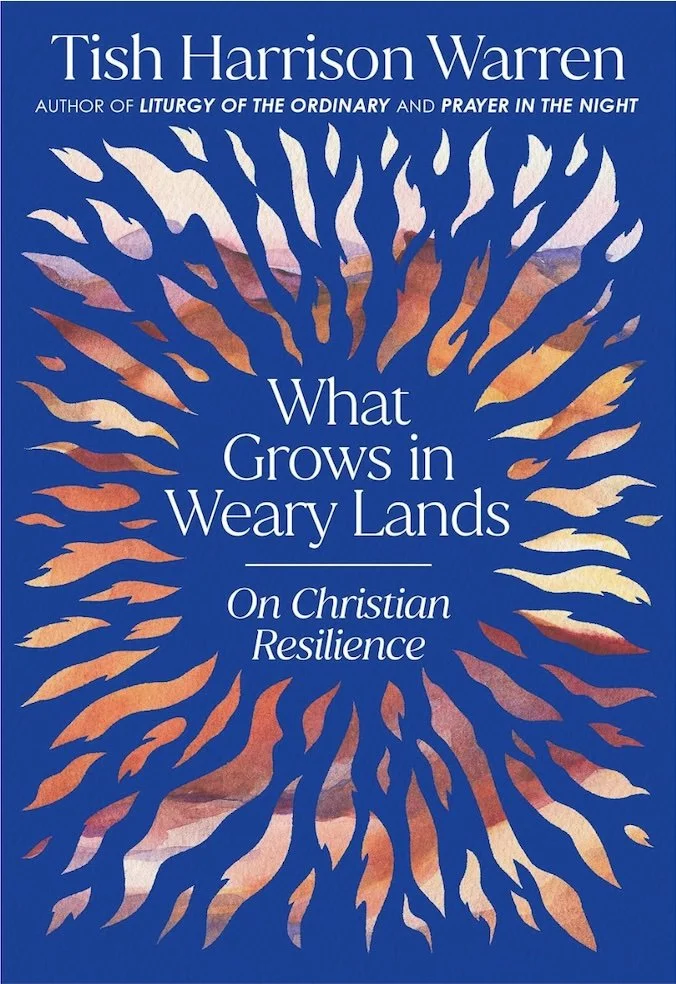
What Grows in Weary Lands, by Tish Harrison Warren
A book on resilience for weary souls — and a timely word for anyone whose ministry has left them running on fumes. Here is a quote from the above book:
“Fifteen years ago, in his book The Shallows: What the Internet Is Doing to Our Brains, Nicholas Carr argued that the internet was rewiring our brains to take in many small snatches of information to the point that we lose the ability to sit with one conversation or keep up with a long argument. The Titanic disaster that this represents for theological rigor, spiritual practices, and the contemplative life cannot be overstated.
Being constantly filled up makes us empty. We cannot, as a species, thrive without blank spaces in our day. I suspect it is no accident that reports of burnout and exhaustion have surged as smartphones have become ubiquitous. What smartphones often take from us are those little moments of margin in our days, natural times of silence and stillness that we once took for granted.”
Tish Harrison Warren
“As often as possible Jesus withdrew to out-of-the-way places for prayer.”
Worth Reading:

A mixed bag of interesting articles this month — from wrestling with AI's place in Christian writing, to the pursuit of happiness, unity in the church, stewardship, missions strategy, and getting more out of Sunday's sermon. Enjoy!
-
A thoughtful, even-handed look at how pastors and ministries should think about AI-assisted writing, and where the real line is.
TGC, AI, and the Democratization of Competence →
“As blogs gave everyone a platform, AI may give everyone an editor.”
Tim Challies
-
A gentle reminder that happiness was never meant to be pursued directly — it's the overflow of a life turned outward, toward God and others.
-
A short piece on what it means to stay unified across real differences within the church.
-
A reflection on stewardship and what it looks like to hold what God has entrusted to us with an open hand — the “treasure in jars of clay” of 2 Corinthians 4:7.
-
A missionary's case for prioritizing the training of indigenous pastors over simply sending more missionaries — sobering and worth a pastor's attention.
Pastors, Not Just Missionaries →
“The nations need more shepherds who will never leave.”
— Philip Hunt
-
Seven small, practical habits for getting more out of the sermon you hear each Sunday — worth passing along to your own congregation.
Worth Singing:
‘He giveth more grace when the burdens grow greater,
He sendeth more strength when the labors increase;
To added affliction He addeth His mercies,
To multiplied trials His multiplied peace.
When we have exhausted our store of endurance,
When our strength has failed ere the day is half done,
When we reach the end of our hoarded resources
Our Father's full giving is only begun.
His love has no limit, His grace has no measure,
His power no boundary known unto men;
For out of His infinite riches in Jesus
He giveth and giveth and giveth again.’
Annie Johnson Flint
And a closing prayer:

Dear Lord and Savior Jesus Christ, I hold up all my weakness to your strength, my failure to your faithfulness, my sinfulness to your perfection, my loneliness to your compassion, my little pains to your great agony on the Cross.
I pray that you will cleanse me, strengthen me, guide me, so that in all ways my life may be lived as you would have it lived, without cowardice and for you alone. Show me how to live in true humility, true contrition, and true love.
Amen.
The Book of Common Prayer
Grace & Peace,
